Best Anti-Fatigue Mats for Standing Desks: Foam vs Gel, Flat vs Terrain
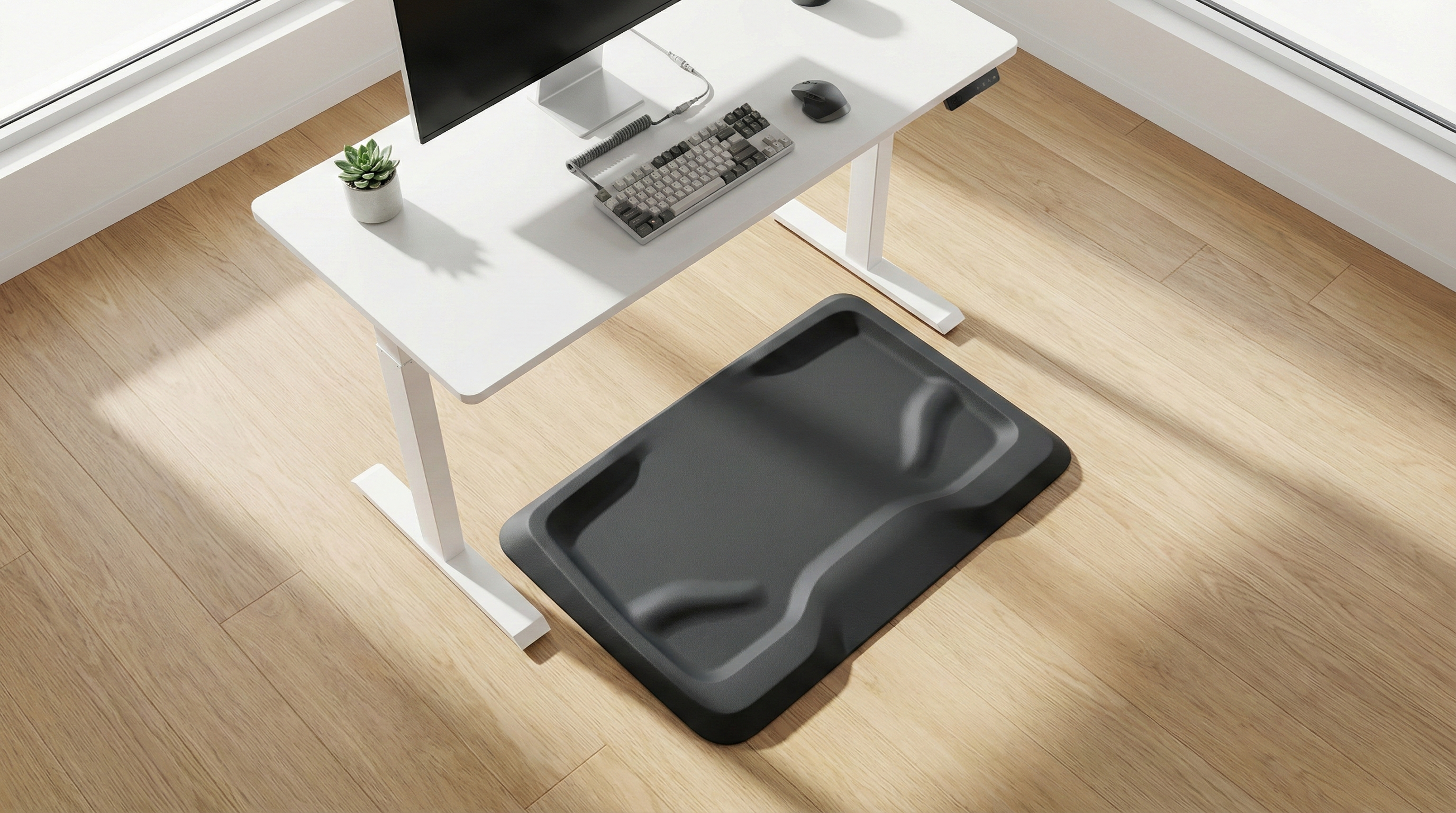
Quick Answer: The best anti-fatigue mat depends on how you stand. For active standers who shift weight frequently, get a terrain mat like the Ergodriven Topo ($99) — its 3D surface encourages movement without you thinking about it. For budget-conscious buyers, the ComfiLife or Gorilla Grip ($30-40) flat foam mats offer excellent cushioning. Look for at least 3/4" thickness, and avoid cheap kitchen mats — they compress flat within months.
TL;DR — Quick Picks
- Best Overall (Terrain): Ergodriven Topo — encourages movement, 7-year warranty
- Best Budget: ComfiLife Anti-Fatigue Mat — common budget pick, 3/4" thick
- Best Value: Gorilla Grip — common value pick for flat foam mats
- Best for Heavy Users: AcroMat 100-1 Series — Custom sizes, lifetime warranty, no weight limit
- Best Desk Brand Mat: Uplift Standing Desk Mat — designed specifically for standing desks
Key rule: Minimum 3/4" thickness. Anything thinner is "basically useless" according to Reddit users.
Do You Actually Need an Anti-Fatigue Mat?
If you're standing for more than 30 minutes at a time, the short answer is yes. The difference is dramatic enough that Reddit users describe it as "night and day." One user who's been using a standing desk for 10+ years put it simply: "Without the mat you will mess up your knees."
Here's what happens when you stand on a hard floor: your body locks into a static position to maintain stability. Blood pools in your legs, muscles fatigue from constant micro-corrections, and your joints absorb impact with every small shift. An anti-fatigue mat solves this by creating an unstable (but supportive) surface that encourages constant micro-movements. These tiny shifts keep blood flowing, engage different muscle groups, and distribute pressure across your feet.
The practical benefit? Users consistently report being able to stand 2-3x longer with a mat than without. One Redditor noted: "I spend 95% of my week standing and I couldn't do that without the mat." If your standing desk is collecting dust because standing hurts, a mat is likely the missing piece.
Types of Anti-Fatigue Mats
Not all standing desk mats are created equal. The three main categories serve different standing styles and preferences:
Flat Foam Mats ↗
The most common and affordable option. Flat mats provide a cushioned surface without any terrain features — just consistent padding across the entire surface. They're the entry point for most standing desk users and work well for people who don't move around much while standing.
Quality flat mats use high-density polyurethane foam that maintains its cushion over years of use. Cheap mats use PVC foam that compresses flat within months — this is why "kitchen mats" are a bad choice for standing desks despite looking similar. The key differentiator is density: press your thumb into the mat, and quality foam should spring back immediately. If it stays compressed, it won't last. Popular options include ComfiLife, Gorilla Grip, and Sky Solutions, all in the $30-45 range.
Terrain/Topo Mats ↗
Terrain mats (also called "topo" or "calculated terrain" mats) have a 3D surface with bumps, ridges, and contours designed to encourage foot movement. The idea is that your feet subconsciously explore the terrain features, preventing the static standing that causes fatigue. It's like having a gentle foot massage while you work.
The most popular terrain mat is the Ergodriven Topo ($99-119), which has been the New York Times' top pick for 8 years running. Users describe the experience as surprisingly engaging — "your brain subconsciously explores the features without being distracting like a balance board." The Topo also has a clever design feature: it slides easily when you step off with one foot, so you never have to bend down to move it. Terrain mats are overkill for casual standing but transformative for people who stand 4+ hours daily.
Industrial/Commercial Mats ↗
Originally designed for factory workers and bartenders who stand 8+ hours on concrete, industrial mats prioritize durability and long-term support over plush comfort. They're typically made from nitrile rubber or dense polyurethane with a tough outer skin that resists wear, chemicals, and punctures.
For home office use, industrial mats make sense if you're a heavier user (250+ lbs), need custom sizing for an unusual desk setup, or simply want a "buy it for life" product. AcroMat, a family-owned company in Minnesota, offers the 100-1 Series with a lifetime warranty against compression and edge curling — they're used by Nordstrom, Stitch-Fix, and H-E-B distribution centers. The trade-off is that industrial mats are firmer than consumer options and designed for use with shoes.
Shop by Mat Type
- Flat foam mats — $25-50, best for beginners and budget buyers
- Terrain/topo mats — $80-120, best for serious standers
- Industrial mats — $50-150+, best for durability and heavy users
Foam vs Gel: Which Material Is Better?
This is one of the most common questions, and the answer depends on how you stand:
| Factor | Foam Mats | Gel Mats |
|---|---|---|
| Best for | Active standers who shift weight | Static standers, foot conditions |
| Feel | Responsive, springs back | Soft, conforms to feet |
| Movement | Encourages micro-movements | Cushions in place |
| Durability | 3-5 years (quality foam) | Can crack with UV exposure |
| Price range | $25-120 | $40-150 |
| Weakness | Cheap foam compresses flat | Can be too soft (unstable) |
The bottom line: For most standing desk users, high-density foam is the better choice. It promotes the micro-movements that make standing beneficial, and quality foam lasts years. Gel mats shine for people with plantar fasciitis, chronic foot pain, or jobs requiring standing in one spot for hours — but they can feel "too squishy" for active work where you're shifting and moving naturally.
Shoes vs Barefoot: What Works Best?
This depends entirely on your mat type and personal preference — there's no universal right answer.
Barefoot/socks works well with: Terrain mats (like Topo), soft foam mats, and any mat designed for home use. Going barefoot lets you feel the mat's surface features and notice fatigue in your feet earlier — which actually helps because it encourages you to sit down before problems develop. One Topo user noted: "I've used shoes and barefoot. I find barefoot to be more comfortable."
Shoes work better with: Industrial mats, firmer commercial mats, and any mat designed for workplace use. These mats assume you're wearing shoes and provide support accordingly. Standing barefoot on an industrial mat can feel too firm, while standing in hard-soled dress shoes on a soft home mat can feel unstable.
The hybrid approach: Many home office users keep supportive slippers or Crocs at their desk (yes, really — multiple Reddit users swear by Crocs for standing desk work). This gives you cushioning from both the mat and footwear without the heat and restriction of regular shoes. As one user put it: "Real talk, get a pair of Crocs. They're ugly, but super effective."
What to Avoid
Before you buy, know what doesn't work:
- Kitchen mats — They look similar but aren't designed for prolonged standing. They compress quickly and provide minimal support after a few months. As one Reddit user warned: "Avoid anything labeled for the kitchen. They just aren't meant for long-term standing."
- Mats thinner than 3/4" — Anything under 3/4 inch thick is "basically useless" according to experienced users. The cushioning effect is negligible, and thin mats wear out faster.
- Memory foam — Despite sounding comfortable, memory foam is a poor choice for standing mats. It compresses under sustained pressure and doesn't spring back, leaving you standing on a flat, unsupportive surface.
- Mats that are too soft — If a mat feels like standing on a pillow, it's probably too soft. Excessive softness causes instability and can actually increase fatigue as your muscles work to maintain balance.
- Generic "anti-fatigue" mats from big-box stores — Many cheap mats use the "anti-fatigue" label loosely. Check reviews specifically from standing desk users, not general purchasers.
Top Picks by Category
Best Overall: Ergodriven Topo
Price: $119 ($99 with code TOPO-20) | Type: Terrain | Warranty: 7 years
The Topo has been the go-to recommendation for serious standing desk users for nearly a decade. Its "calculated terrain" surface features — rails, bumps, a massage ball, and a calf-stretch wedge — encourage constant foot movement without requiring conscious effort. Users consistently describe it as a game-changer: "I migrated from a plain fatigue mat to the Topo. It's made a huge difference and allows me to comfortably shift my weight whenever I feel the need."
The Topo also solves the annoying mat-movement problem: it's designed to slide easily when you step off with one foot, but stays put when you're standing on it. No more bending down to reposition your mat throughout the day. The main downsides are price and a 240 lb weight limit for optimal performance (though the 7-year warranty applies regardless of user weight).
Best Budget: ComfiLife Anti-Fatigue Mat
Type: Flat foam | Warranty: Manufacturer's warranty
The ComfiLife is a common budget pick because it is 3/4" thick high-density foam with beveled edges, and it works both with shoes and barefoot. It's also one of the softer mats if you prefer plush cushioning over firm support.
Reddit users praise it as an excellent starting point: "I got the ComfiLife anti-fatigue mat for my standing desk and it's way more comfortable than standing on the hard floor. Works fine with or without shoes but feels better without." The main limitation is durability — expect 2-3 years of heavy use before noticeable compression.
Best Value: Gorilla Grip
Price: ~$35 | Type: Flat foam | Warranty: 10-year guarantee
The Gorilla Grip offers similar quality to ComfiLife but with better reported longevity. Multiple Reddit users mention using theirs for 3+ years without significant compression. At 3/4" thick with a supportive (not too soft) feel, it hits the sweet spot for daily standing desk use.
One user summed it up: "This is a super old post but I don't see anyone recommend Gorilla Grip. I'm on my 3rd year and it's actually amazing." The brand also offers multiple sizes and colors if aesthetics matter for your setup.
Best for Heavy Users: AcroMat 100-1 Series
Price: Custom (varies by size) | Type: Industrial nitrile rubber | Warranty: Lifetime
If you're over 250 lbs or simply want a "buy it for life" mat, AcroMat is worth the investment. This Minnesota-based company primarily serves industrial clients (aerospace, food manufacturing, distribution centers) but sells directly to consumers. Their 100-1 Series is 100% nitrile rubber that's impervious to liquids, won't curl at the edges, and carries a lifetime warranty against losing its cushion.
The standout feature is custom sizing — you can design a mat to exact dimensions using their AcroSketch tool, shipped in under 5 days. Standard sizes (2-6 ft wide) are 20-25% cheaper than custom. As one of their team members explained on Reddit: "We've gotten a lot of standing desk purchases because of the comfort and especially durability." Note: these mats are designed for use with shoes.
Best Desk Brand Option: Uplift Standing Desk Mat
Price: $69 | Type: Flat foam | Warranty: Uplift warranty
If you bought your standing desk from Uplift, their matching mat is a solid choice. It's designed specifically for standing desk use (not repurposed from kitchen or industrial applications), with beveled edges and appropriate firmness for extended standing.
A Reddit user noted: "The fatigue mat that came with my Uplift desk is actually really good. I use it without shoes usually. My dog likes to sleep on it too." At $69, it's priced between budget options and premium terrain mats — a good middle ground if you want quality without the Topo's price tag.
Frequently Asked Questions
Do I really need an anti-fatigue mat for my standing desk?
Yes, if you stand for more than 30 minutes at a time. Users report mats can triple comfortable standing time. Standing on a hard floor causes fatigue, joint pain, and discourages standing altogether. Most users describe the difference as "night and day."
What thickness should an anti-fatigue mat be?
At least 3/4 inch (19mm). Thinner mats provide minimal cushioning and compress quickly. The sweet spot is 3/4" to 1" — thick enough for comfort but not so thick that you feel unstable.
Should I use an anti-fatigue mat barefoot or with shoes?
Depends on the mat. Terrain mats work great barefoot. Flat foam mats work either way (many prefer barefoot). Industrial mats are designed for shoes. Going barefoot helps you notice fatigue earlier, encouraging healthy sit-stand transitions.
What's the difference between foam and gel mats?
Foam promotes micro-movements (better for active standers). Gel redistributes pressure (better for static standing and foot conditions). Most standing desk users prefer foam for its responsive feel and durability.
Are terrain/topo mats worth the extra cost?
For serious standing desk users (4+ hours daily), yes. They encourage subconscious movement that reduces fatigue. For casual use, a quality flat mat ($30-40) is a good starting point.
How long do anti-fatigue mats last?
Cheap PVC foam: 1-2 years. Quality polyurethane foam: 3-5 years. Industrial nitrile rubber (like AcroMat): lifetime warranty. The Topo has a 7-year warranty.
What's the weight limit for anti-fatigue mats?
Most mats don't specify. The Ergodriven Topo works optimally up to 240 lbs. Industrial mats like AcroMat have no practical weight limit. For users over 250 lbs, consider commercial-grade options.
Can I use a yoga mat instead?
As a temporary solution, yes — some Reddit users recommend it. Yoga mats are easy to roll up and stow. However, they're thinner than proper anti-fatigue mats and won't provide the same long-term support. Good for testing if you'll use a mat before investing.